Reflex is a single page app framework written in Haskell compiled to JavaScript. A major concern with reflex is the slow loading times, this can be mediated however by doing server side rendering1. This blog post will discuss how to do that2.

The
![[]](/theme/images/category-tools.svg)
![[]](/theme/images/category-pain.svg)
A client had a Citrix environment running. To debug the deployment of a machine, I copied the Citrix environment locally in VirtualBox. Note that the server doesn’t run any machines inside citrix, but it does get the XenCenter operational. It appears that in nixos you can just setup a local
This is a post of things I wanted to do in nixos but isn’t described anywhere. I had to read source code to figure these things out. By explaining here what is going on I make things easier for other people.

It’s possible to bypass
In the previous blog post we saw interaction with servant in reflex. Although that covers the basics, there are several more hurdles to overcome to get comfortable with Reflex. I think most of these are encountered by building a simple login system. So let’s build something like:
                   	   +------------------+
+-----------+ |![[]](/theme/images/category-technique.svg)
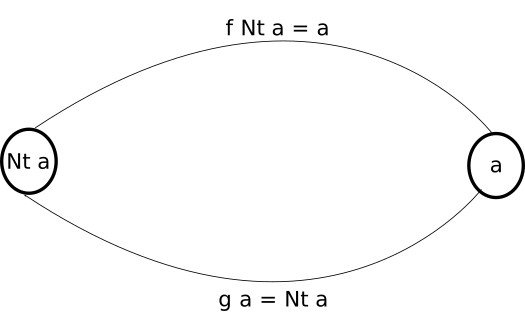
All newtypes are isomorphisms
– My mother
Control.Lens.Wrapped uses the isomorphism property to introduce a type class Wrapped. Let’s explore use cases, because after all, it doesn’t appear to do much at first glance. What’s the point of formalizing wrapping and unwrapping of
In the pragmatic haskell series, we saw how to setup a simple webserver with database. But at some point you still need a frontend. If it were 2005 you may have been able to get away with just blaze. But we are in 2018+, and JavaScript is a problem
![[]](/theme/images/category-story.svg)
After a year in foreign countries, I’ve returned home. Last week my working holiday visa expired, and unlike a friend of mine, I did not want to be deported in handcuffs.

I quite enjoyed my stay in Australia, the people are relax, life is good. I’ve drank lots
Nixos is heroin for tinkerers. Paradise can be tinkered together and be freely shared among peers because it’s fully reproducible! Jappie wanted more, he wanted a secure disk and a BTRFS. There used to be no guides for this, now there is.

The bullet was bitten,
Note, I no longer recommend using beam for business as ORM. Please use persistent instead. Beam is far to complicated for it’s use case. Migrations can be run with postgresql-migration for example, using the suggested migrations from persistent. I’d only recommend using beam for hobby projects or as a case
Most Haskell language guides will leave IO until later. This guide is different, this guide is about using Haskell. Our focus is different: We build first, then learn trough delight.